Simple TCM tips for better energy, sleep, immunity and seasonal wellness.
By Blaise T. Ryan, R.TCMP, R.Ac
November 9th, 2026
The last leaves are falling, daylight is fading earlier, and the warmth of home feels a little more inviting. In the traditional Chinese calendar, this transition is marked by Li Dong (立冬), the “Beginning of Winter,” which falls on November 7 in 2026. One of the 24 solar terms, Li Dong signals the start of winter in this seasonal framework—even when the weather in Ottawa–Gatineau still feels like late autumn.
For generations, these solar terms have offered a way to observe nature’s changing rhythms and adjust daily life accordingly. They also offer a useful lens for Yang Sheng (養生), the Chinese art of “nourishing life.”
This brings self-care for our health into everyday choices: how we eat, move, rest and tend to our emotional well-being. Rooted in ancient Chinese medicine, adapting to the changing seasons yields greater health resilience.
As autumn’s gathering gives way to winter’s storing, this tradition invites us to protect our warmth, nourish ourselves deeply and leave more room for recovery. You may already notice a desire for warmer meals, more sleep or a quieter pace. Changes in daylight can also touch our mood and energy, making comfort and connection especially valuable.
Li Dong is an invitation to adapt with the season. A nourishing bowl of soup, a walk in the daylight, an extra layer or an earlier bedtime can become small, meaningful ways to care for ourselves. The following five Chinese medicine tips bring this ancient seasonal wisdom into modern life, helping us approach the colder months with greater awareness, warmth and steadiness.

What does it mean to preserve Yang Qi?
In Traditional Chinese Medicine, Yang Qi describes the warming, activating aspects of the body’s functioning. It is involved in how we understand warmth, movement, digestion and vitality. It is a traditional framework, rather than a measurable substance or a direct equivalent of metabolism.
The Huangdi Neijing, or Yellow Emperor’s Inner Classic, describes those who understood how to preserve their energy:
“They ate and drank in moderation, kept regular daily rhythms, and did not exhaust themselves through excessive exertion.”
This simple wisdom takes on particular meaning as winter approaches. In Chinese medicine, winter corresponds to the Kidneys, understood as a functional system that stores our Jing, or foundational essence, and provides the roots of both Yin and Yang. Kidney Yang is often compared to an inner fire: the warming, activating aspect that supports the body’s warmth, digestion and vitality.
Winter’s invitation is to tend that fire with care. Nourishing meals, regular sleep, comfortable warmth and movement balanced with recovery are practical ways to support our reserves. Protecting Yang Qi also means nourishing Yin—the rest, fluids and deeper replenishment that allow warmth and activity to remain sustainable.
We still have jobs, children and responsibilities. But we can notice when we are repeatedly spending more energy than we restore, and make small adjustments. Caring for ourselves through winter begins with giving the body opportunities to replenish.
Preserving Yang does not mean continually stimulating ourselves with strong herbs, hot spices or intense exercise. The same chapter advises nourishing Yin in autumn and winter. Rest, fluids and nourishment belong alongside warmth. Both aspects matter.
1. Choose warm, nourishing foods for colder days
As cold, damp weather becomes more common, Chinese dietary practice often favours cooked meals that feel comfortable and satisfying to digest.
Think of oatmeal instead of an icy smoothie on a chilly morning, soup at lunch, or roasted vegetables with lentils, tofu, eggs or another source of protein at dinner.
Some simple colder season meals include:
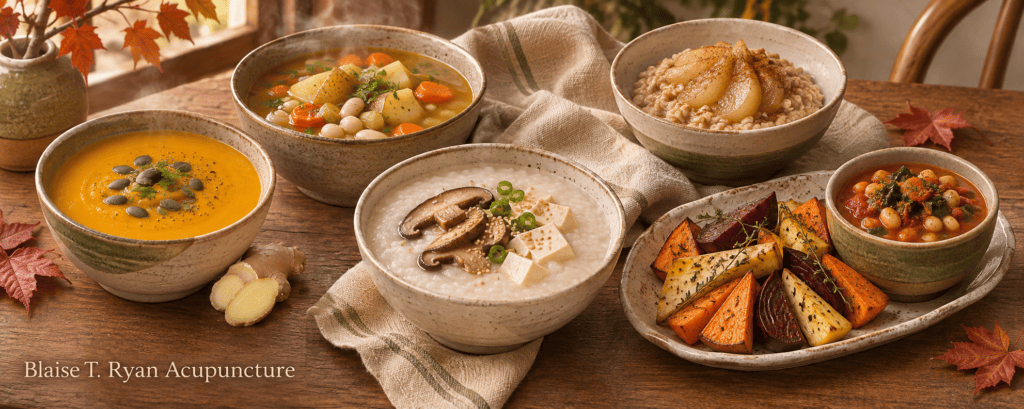
- Squash and red lentil soup with a little ginger.
- Potato, carrot and white bean soup.
- Rice congee with mushrooms and an egg or tofu.
- Stewed apples or pears with oatmeal.
- Roasted root vegetables with a hearty bean stew.
In TCM, the Spleen and Stomach describe a functional system concerned with receiving food and transforming it into nourishment. Supporting this system is one reason cooked foods feature so strongly in seasonal dietary advice.
You do not need to eliminate every raw food or follow a rigid winter diet. Notice what agrees with you. If cold drinks and large raw salads consistently leave you bloated or uncomfortable, try warmer alternatives and observe the difference.
Use ginger, cinnamon and other warming flavours in ordinary culinary amounts if they suit you. More is not always better: strong spices may be uncomfortable when you already have reflux, a burning throat or a tendency to feel overheated.
2. Keep your neck, feet and lower back warm
“Avoid cold and seek warmth.”
This is straightforward advice for a November day: dress for the actual weather, bring an extra layer, and change out of wet shoes or clothing when you come inside.
If you tend to feel chilled, pay particular attention to keeping your neck, feet, lower back and lower abdomen warm. A scarf, warm dry socks, and layers that cover your waist can make a real difference to how comfortable you feel. At home, change out of damp socks and keep your feet warm on cold floors.
In TCM, protecting these areas is a way of preserving Yang Qi and guarding against what we traditionally describe as the invasion of Wind, Cold and Damp. The neck is considered particularly vulnerable to Wind, while the lower back and lower abdomen are important areas for nurturing the body’s foundational warmth, associated with Kidney Yang and the lower dantian. Think of it as tending your inner warmth as the world outside cools down.
Aim for comfortable warmth. Adjust layers as you move so that you do not become soaked with sweat and then chilled when you stop.
In Chinese medicine, “Cold” and “Damp” describe both environmental influences and patterns of symptoms. Dampness may be used to describe heaviness, sluggishness or certain digestive and mucus-related patterns. It does not mean that every congested person has the same imbalance, or that damp weather directly causes an infection.
3. Support your sleep with rest and daylight
When daylight saving time ends in Ottawa–Gatineau, the clocks move back, but our bodies may take longer to catch up. Sleep and appetite do not always adjust immediately.
“Go to bed early and rise late; wait for the daylight.”
— Yellow Emperor’s Inner Classic, Suwen, chapter 2
Few families can simply wait until sunrise to begin their day. We can still apply the underlying idea by allowing enough time for sleep and reducing the pressure to stretch every evening.
Keep your bedtime and waking time reasonably consistent. On sunny days, make a little room to step outside and soak up some sunshine: take a lunchtime walk, sit in a sheltered spot, or enjoy a few quiet moments in the sun. Daylight helps anchor our sleep–wake rhythm, and in a TCM understanding, the sun’s warmth offers a welcome connection with Yang as the days grow shorter.
Give yourself a quieter hour before bed with less bright light and fewer demands. If afternoon coffee is carrying you through to bedtime, consider moving it earlier.
From a TCM perspective, autumn invites us to gather our energy inward, while winter asks us to store and replenish it. Sleep is understood as a time for Yang to settle inward and the Shen, or spirit, to become quiet, while Yin and Blood are nourished.
Allowing more space for rest during this transition helps us harmonize our daily rhythms with changing weather and light. In this traditional understanding, we function more efficiently when activity and recovery are in balance, building the reserves that support resilience through the colder months.
An earlier bedtime or a quieter evening can be a small act of seasonal wisdom: giving your body time to find its rhythm in the season you are actually living in.

4. Move your Qi with walking and qigong
The colder months are still a good time for walking, strength work and other regular movement that suits your health and fitness.
Within a TCM approach, the aim is to keep Qi moving while respecting your reserves. A walk during daylight, a short qigong practice, or gentle mobility work can be particularly approachable on a tired day.
When you walk, let your arms swing naturally, with relaxed shoulders and easy breathing. This gentle movement through the arms and chest is understood in TCM to encourage the circulation of Qi through the channels, including those associated with the Lungs. There is no need to force the swing or take exaggerated breaths.
Qigong brings together relaxed movement, breath and attention. Gentle arm swings and comfortable opening and closing movements of the chest are traditionally used to move and harmonize Qi and keep the channels open. Because the Lungs are understood to distribute Qi toward the body’s surface, these practices fit naturally into a seasonal approach to supporting Lung Qi and Wei Qi, our protective Qi.
Even five or ten minutes can be a manageable daily practice. Finish feeling comfortably warm and refreshed.
Pay attention to how you feel afterwards. If every workout leaves you depleted for the rest of the day, adjust the intensity and allow more recovery. You do not need to stop vigorous exercise simply because it is November; match it to your capacity and the conditions.
5. Support Wei Qi and recognize early cold patterns
Chinese medicine describes Wei Qi, often translated as protective Qi, as helping to warm and defend the body’s surface and regulate the opening and closing of the pores. Its relationship with the Lungs makes it especially relevant to seasonal respiratory care. Wei Qi is a traditional concept, rather than a direct equivalent of the immune system.
Supporting it begins with the habits we repeat: nourishing the Spleen and Stomach with regular, satisfying meals; allowing enough sleep; keeping warm when chilled; and using gentle movement and breathing to support the Lungs. If you are already exhausted, making space for recovery may be more helpful than pushing through another demanding day.
Choosing a tea or herbal formula for early symptoms
At the first signs of feeling unwell, slow down, rest and pay attention to the pattern of symptoms. In TCM, herbs used to “release the exterior” and expel an early external pathogen are chosen differently from herbs used to build strength between illnesses.
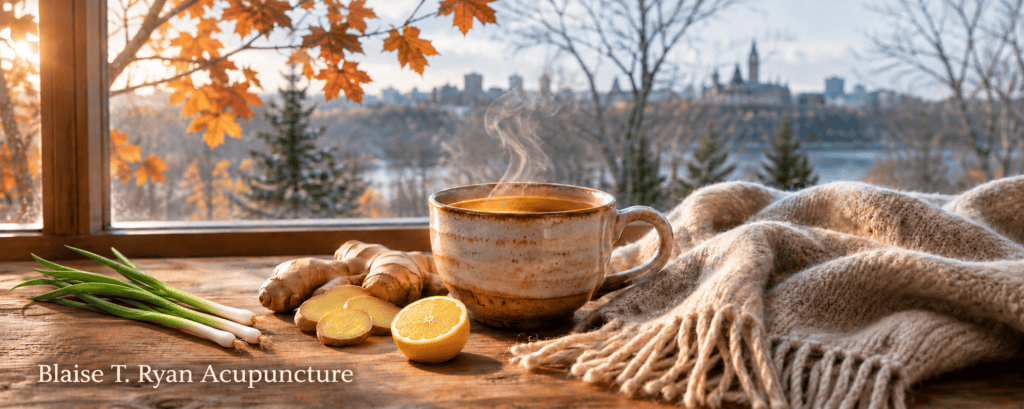
Scallion and ginger tea: a warming Wind-Cold approach
The white part of scallions, known as Cong Bai, and fresh ginger, Sheng Jiang, are traditionally used to gently disperse Wind-Cold. A simple culinary tea made by briefly simmering a few slices of fresh ginger and the white part of a washed scallion in water may suit an early pattern of chills, sneezing and a clear runny nose.
It is less appropriate when a hot, painful throat, marked thirst or feeling overheated predominates. Keep it mild; forcing a heavy sweat is not the goal.
Lemon–honey–ginger tea: a comforting warm drink
A little fresh ginger steeped in hot water, with honey and a squeeze of lemon added once comfortably warm, can be a soothing drink. In Chinese dietary terms, ginger is warming and honey is moistening.
Use less ginger if you feel hot or your throat feels burning, and omit lemon if it irritates your throat or reflux. This is a comfort drink, not a promise to stop an infection. Never give honey to children under one year.
Yin Qiao San: a traditional Wind-Heat formula
This classical formula is traditionally used for early Wind-Heat patterns, often involving sore throat, fever, thirst and mild chills. It serves a different purpose from warming scallion–ginger tea and is not the right formula for every cold. A practitioner can help determine whether it fits your presentation.
Individualized herbal support at our clinic
At our clinic, we have a variety of TCM herbal formulas to support seasonal health. Depending on your needs, we may recommend a formula traditionally used to strengthen Lung and Spleen Qi and support Wei Qi between illnesses, or one aimed at relieving an early external pattern. Our goal is to support your resilience and immune health with an approach matched to your constitution and symptoms, rather than a single formula for everyone.
Herbal formulas can interact with medications and are not suitable for every person. Ask for individualized guidance, especially for children, during pregnancy or breastfeeding, or if you take medication. Strengthening formulas and formulas for acute symptoms are not interchangeable, and neither is a guaranteed way to prevent or stop an infection.
These practices sit alongside fresh indoor air, handwashing and staying home when ill. Respiratory infections are caused by infectious organisms; the TCM language of Wind, Cold and Damp describes a traditional way of understanding patterns of illness, rather than the creation of viruses by the weather.
Yang Sheng Fa: nourishing life through the seasons
Yang Sheng Fa means methods of nourishing life. It is the everyday practice of caring for our vitality through food, movement, rest and the way we respond to the world around us. Seasonal living is one of its foundations.
“Gather the spirit and Qi inward, allowing autumn’s Qi to find balance.”
— Yellow Emperor’s Inner Classic, Suwen, chapter 2
We can bring that spirit into November by leaving a little more space between commitments, enjoying a warm meal without rushing, and allowing the evening to become quieter. Gathering inward need not mean withdrawing from life. It can mean giving our energy a place to settle.
As winter approaches, the same chapter advises:
“Let the will rest as though hidden, as though holding something precious within, as though already fulfilled.”
— Yellow Emperor’s Inner Classic, Suwen, chapter 2
There is something reassuring in this image. We do not need to be constantly producing or reaching for more. Some seasons ask us to appreciate what we have, protect what nourishes us, and make room for renewal.
The chapter calls this winter approach:
“The way of nourishing storage.”
— Yellow Emperor’s Inner Classic, Suwen, chapter 2
The care we give ourselves now helps lay the foundation for the seasons ahead. A little more warmth, a little more rest, and steady, nourishing routines are ways of putting this wisdom into practice.
Personalized Chinese medicine care in Ottawa–Gatineau
There is no single November prescription that suits everyone. Someone who feels cold, tired and bloated needs a different conversation from someone who feels hot, dry and restless.
At our Ottawa acupuncture and Chinese medicine clinic, serving patients across Ottawa–Gatineau, we consider your symptoms alongside your sleep, digestion, daily habits and overall health. A consultation can help you explore an individualized approach to food and lifestyle, and discuss whether acupuncture or Chinese herbal medicine is appropriate for your concerns.
Persistent fatigue, recurring infections or a lingering cough deserve medical assessment as needed; they should not automatically be attributed to a seasonal TCM pattern. Seek prompt medical care for difficulty breathing, chest pain or a worsening illness. Contact the clinic before attending if you have symptoms of an acute respiratory infection.
For now, choose one thing that feels manageable: a pot of soup, an extra layer, a walk in the sunshine, or an earlier bedtime.
You do not have to change everything to begin caring for yourself differently. Let these small habits become a way of listening to the season—and to yourself. The warmth and rest you make room for today are part of how you nurture the energy you will draw on tomorrow.
Book an acupuncture appointment or TCM consultation.
Common Concerns Acupuncture May Help With This Fall and Winter
Sometimes, warmer meals and earlier nights are only part of what we need. If recurring symptoms are making it difficult to enjoy the season, acupuncture may offer additional support.
- Neck, shoulder and lower back pain: If cooler weather or changes in your activity bring familiar aches to your attention, acupuncture may help manage certain types of persistent musculoskeletal pain.
- Tension headaches and migraines: Acupuncture may help reduce the frequency of these headaches—worth considering if they regularly interrupt your work, sleep or family time.
- Allergy-related nasal symptoms: For people with allergic rhinitis, acupuncture may help ease symptoms such as sneezing and a runny or blocked nose. An assessment can help distinguish allergies from other causes of congestion.
Changes in sleep, stress, energy and mood also deserve attention. These are important parts of your TCM assessment, helping us understand how you are experiencing the season and tailor your care. Persistent fatigue or low mood may also need assessment by your primary care provider; acupuncture can be considered alongside appropriate care.
At Blaise T. Ryan Acupuncture, we support people in the Ottawa–Gatineau region with individualized treatment and practical guidance that fits daily life.
Curious about whether acupuncture could help you?
Book an appointment or a complimentary 15-minute Acupuncture Consultation to discuss your concerns and explore your next step.