Why Summer Is One of the Best Times to Use Acupuncture to Treat Winter & Fall Health Conditions.
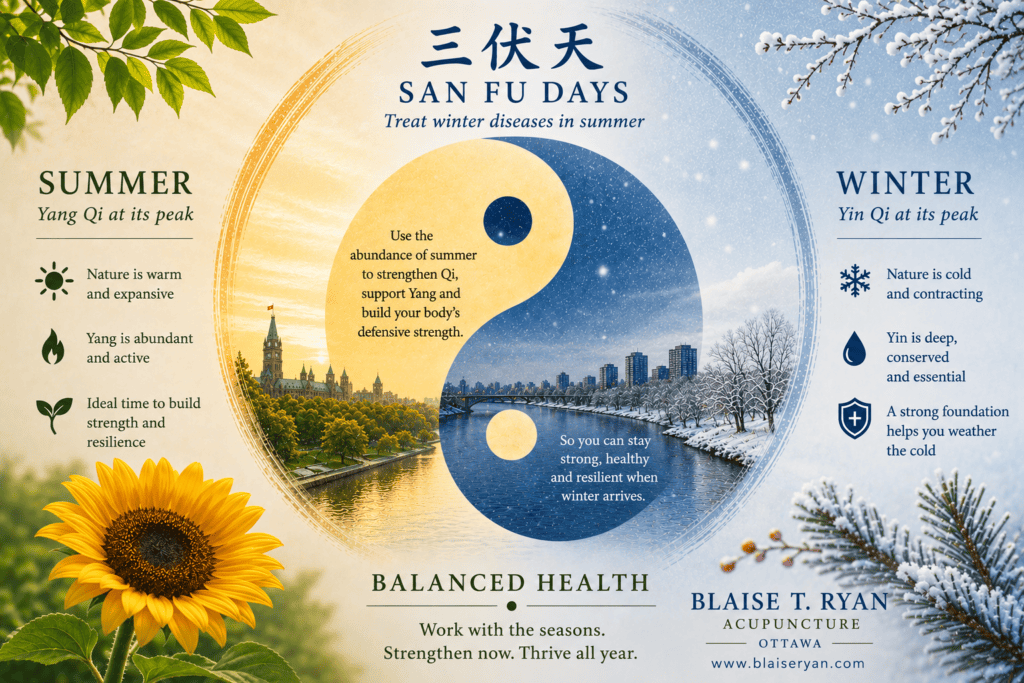
What are San Fu Days? The ancient traditional Chinese medicine practice of “treating winter diseases in summer”.
If winter is your least favourite season because of how it affects your health, then San Fu treatments may be for you.
Maybe your cold hands and feet, arthritis, chronic pain, asthma, allergies, frequent colds or low mood get worse when Ottawa’s colder weather arrives, The last thing you probably think about is addressing these health issues in the middle of summer, but this according the Chinese medicine this can be an optimal time to help resolve these issues for good! How? Let me explain…
Traditional Chinese Medicine (TCM) looks at your body according to the balance of Yin & Yang; Blood and Qi, Cold and Hot, Water and Fire, recovery and activity and rest and stress – to name a few of the Yin Yang polarities that are important to balance for sustainable health.
When your health worsens in winter, that is a sign of a Yin Yang imbalance. Usually it indicates a Cold or Yin blockage or a Yang or Qi deficiency.
Rather than waiting for seasonal symptoms to return when the weather gets cold, Chinese medicine has a longstanding tradition of using the hottest part of summer, when the Yang Qi is in full flow to strengthen the Qi flow body and heal the imbalance that causes winter illness.
This ancient Chinese health principle is called:
冬病夏治 — Dōng Bìng Xià Zhì
“Treat winter diseases in summer.”
At our Ottawa acupuncture clinic, we use this seasonal approach to help patients address underlying patterns that contribute to recurring cold-weather symptoms—not simply wait until those symptoms return.
Because prevention is the best medicine!
What Are San Fu Days?
San Fu Days (三伏天) are traditionally considered the hottest period of the Chinese calendar, occurring in the weeks following the summer solstice, ending about a month before the fall equinox.
For 2026, the traditional San Fu (三伏天) period runs for 40 days, from July 15 through August 23.
- 初伏 Chū Fú — Initial Fu: July 15–24
- 中伏 Zhōng Fú — Middle Fu: July 25–August 13 (20 days)
- 末伏 Mò Fú — Final Fu: August 14–23
- 出伏 Chū Fú — End of San Fu: August 24
In Traditional Chinese Medicine, summer represents the height of Yang Qi—the warming, active and expansive aspect of the body’s physiology.
Classical Chinese medicine teaches that we should live in harmony with the seasons and adjust clinical treatments based on the seasons as well. Summer therefore presents a unique opportunity to support Yang Qi, and strengthen areas of constitutional weakness to prepare the body for the contracting, cooling seasons of autumn and winter.
This is especially relevant for people whose symptoms or health consistently become worse with cold, damp weather or seasonal change.
What Does “Treat Winter Diseases in Summer” Mean?
The goal isn’t necessarily to treat an active “winter illness” during summer.
Instead, it’s about healing the root-cause. We accomplish this by looking for the underlying pattern that makes a person vulnerable when colder weather arrives.
In TCM, this may involve weakness of the Lung, Spleen or Kidney systems, insufficient Yang Qi, weakened Wei Qi (Defensive Qi), poor circulation of Qi and Blood, or lingering Cold and Damp blockage within the channels.
During San Fu, treatment may focus on strengthening these underlying systems while the body’s Yang is naturally more abundant. Yielding better long-lasting results for healing.
Think of it as preparing the terrain to adapt before the weather changes, rather than waiting for symptoms to return.
What Conditions May Benefit From Summer Acupuncture for Winter Health?
San Fu treatment is particularly relevant when symptoms predictably worsen during fall or winter, or when the underlying TCM pattern involves Cold or deficiency.
We commonly consider this approach for patients experiencing:
Frequent Colds & Respiratory Problems
- Frequent colds and flus
- Recurrent respiratory infections
- Chronic or recurrent cough
- Asthma
- Bronchitis
- Sinus problems
- Allergic rhinitis
- Seasonal allergies
- A tendency to become sick whenever the weather changes
TCM treatment may focus particularly on strengthening Lung, Kidney and/or Spleen Qi and Wei Qi, which traditionally govern the body’s exterior defences.
Cold Hands, Feet & Poor Circulation
People who are chronically cold or whose circulation deteriorates dramatically in winter may particularly appreciate this seasonal approach.
This includes:
- Cold hands and feet
- Raynaud’s phenomenon
- General cold intolerance
- Poor peripheral circulation
- Symptoms that improve noticeably with warmth
Treatment may focus on warming Yang and encouraging the circulation of Qi and Blood.
Arthritis, Joint Pain & Chronic Pain
Cold and damp weather can aggravate many chronic pain conditions.
San Fu treatment may be considered for:
- Arthritis
- Joint pain and stiffness
- Chronic back pain
- Neck and shoulder pain
- Sciatica
- Old injuries that ache during cold or damp weather
- Muscular pain that consistently improves with heat
In TCM, these presentations may involve combinations of Cold, Damp, Qi stagnation, Blood stasis and constitutional deficiency.
Acupuncture, moxibustion and other therapies can be selected according to the individual pattern.
Fatigue & Digestive Weakness
The Spleen system plays a central role in the production of Qi in Chinese medicine.
Patients with Spleen Qi or Spleen Yang deficiency may experience:
- Chronic fatigue
- Poor appetite
- Bloating
- Loose stools
- Feeling heavy or sluggish
- Cold extremities
- Increased fatigue after eating
- Poor appetite or nutrient deficiencies
- Low energy during colder weather
For these patients, treatment may focus on strengthening digestion and supporting the body’s ability to produce and circulate Qi & Blood.
Seasonal Mood & Energy Changes
Some people experience profound changes in energy and mood as daylight decreases.
For patients who struggle with seasonal low mood, fatigue or Seasonal Affective Disorder (SAD), summer can also be a useful time to begin supporting the body before those seasonal changes occur.
Acupuncture can be used as a complementary approach alongside appropriate medical and mental-health care when needed.
Skin & Allergy Conditions
Certain cases of winter skin conditions may also benefit from these treatments, such as:
- Eczema
- Urticaria/hives
- Chronic itching
- Seasonal skin flare-ups
- Allergic conditions
- Dry or cracked skin, fingers or toes
- Dry hair or scalp
Importantly, Chinese medicine does not treat every case the same way. The underlying TCM diagnosis determines whether warming and tonifying treatment is appropriate.
How Do We Use Acupuncture During San Fu Days?
There is no single “San Fu acupuncture treatment.”
Your treatment is individualized according to your symptoms, constitution, pulse, tongue and the underlying root-cause that we determine from your Chinese medicine diagnosis.
When appropriate, treatment may focus on:
- Strengthening Lung, Spleen and Kidney Qi
- Supporting Yang Qi
- Strengthening Wei Qi
- Improving circulation of Qi and Blood
- Warming areas affected by Cold
- Resolving Cold and Damp
- Supporting digestion
- Addressing underlying constitutional deficiencies
- Opening Qi flow in blockages
Acupuncture points such as ST36, REN6, REN12, DU4, DU14, BL13, BL20 and BL23 are often used, depending on the individual presentation.
Moxibustion: An Important San Fu Therapy
Acupuncture isn’t the only therapy we use.
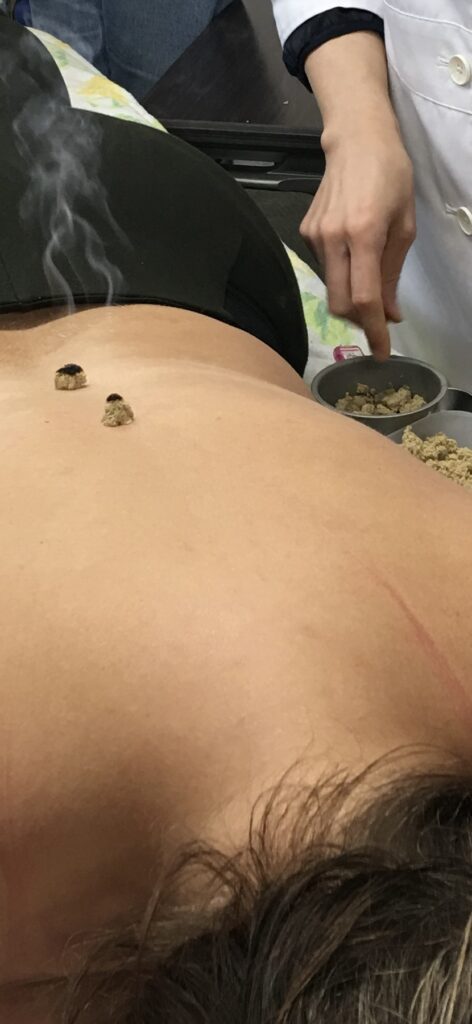
Moxibustion, or moxa, is a traditional Chinese medicine technique in which the herb mugwort (Ai Ye) is burned near specific acupuncture points to provide therapeutic warmth.
Moxa is particularly useful when the clinical presentation involves Cold, Yang deficiency or chronic conditions that improve with warmth.
Depending on the patient, we may combine acupuncture with:
- Moxibustion
- Cupping
- Gua sha
- Chinese herbal medicine
- Dietary therapy
- Lifestyle recommendations
The treatment is always adapted to the individual.
An Important Point: More Yang Isn’t Always Better
San Fu Days do not mean everyone should receive strongly warming or tonifying treatment.
We always diagnose and treat to balance the pattern imbalances that we discover – this is an important distinction in authentic Chinese medicine.
If someone currently presents with excess Heat, Damp-Heat, significant Phlegm accumulation, food stagnation, Qi or Blood stagnation, or an acute external illness, treatment may first need to clear, drain, move or harmonize the excess before significant tonification is appropriate.
Someone can even have an underlying deficiency while simultaneously presenting with an excess or obstructive condition.
This is why professional pattern differentiation (辨证论治) matters.
We aren’t simply “boosting Yang.”
We are using the season strategically while treating the individual who is in front of us.
Two Things You Can Do at Home During San Fu
You can adapt your lifestyle to nourish your own Yang Qi during this time.
1. Protect Your Digestion
Summer naturally makes us reach for cold drinks, ice cream, smoothies and raw foods.
There is nothing wrong with enjoying cooling summer foods – if your gut can tolerate it. From a TCM perspective, constantly chilling the digestive system can weaken Spleen Qi, particularly in people who already experience bloating, loose stools, fatigue or poor digestion. These symptoms may indicate your Spleen Qi is already weakened, so you will benefit from this advice.
Try balancing cooling summer foods with:
- Cooked vegetables
- Rice and other cooked grains
- Soups and broths
- Eggs and other nourishing proteins
- Oatmeal or warm breakfasts
- Room-temperature rather than ice-cold drinks
- Warming spices like ginger, turmeric, cinnamon, rosemary, etc.
The goal isn’t to make yourself hotter. It is to balance cooling foods and support your gut by avoiding overwhelming your digestion with cold.
2. Let Summer Warm Your Upper Back
In Chinese medicine, many important acupuncture points and channels associated with your immune system are located across your upper back.
When you take a hot shower, allow the water to warm your upper back and between the shoulder blades for a few minutes. This warmth will activate your Lung and Wei Qi – your defensive Qi – to make your immune system more efficient.
Think gentle warmth—not extreme heat.
Also, allow yourself to enjoy moderate summer warmth and outdoor activity rather than spending excessive time during the hot season in heavily air-conditioned environments.
What About Children?
San Fu can be particularly relevant for children who experience:
- Frequent winter colds
- Recurrent cough
- Asthma
- Allergies
- Chronic nasal congestion
- Poor appetite
- Loose stools
- Fatigue
- Cold hands and feet
Traditional pediatric Chinese medicine recognizes that the Lung and Spleen systems are still developing in children.
Rather than waiting for the cycle of fall and winter illness to begin again, keeping your child constantly out of school and keeping you worrying – summer acupuncture for winter conditions treatments can focus on strengthening your child’s health beforehand.
Pediatric treatments can be very gentle and may include acupuncture, acupressure, pediatric tui na, non-needle techniques, dietary guidance and other age-appropriate approaches.
When Should You Start?
Start now, while it’s still hot! You don’t need to wait for the first cold October morning.
The San Fu tradition encourages us to think preventatively:
Treat the tendency toward illness before the season that triggers it arrives.
If you already know that every autumn and winter brings back the same problems—summer is an excellent time to discuss that pattern with your acupuncturist.
Prepare for Winter While It’s Still Summer
One of the fundamental ideas in Traditional Chinese Medicine is that our health doesn’t exist independently of our environment.
The seasons change—and our bodies change with them.
San Fu Days remind us that sometimes the best time to treat a problem is before it becomes a problem again.
At Blaise T. Ryan Acupuncture in Ottawa, our team of experienced acupuncturists uses Traditional Chinese Medicine diagnosis to develop individualized treatment plans based on your symptoms, constitution and seasonal patterns.
If your health consistently deteriorates during Ottawa’s colder months, consider using the remaining weeks of summer to begin preparing your body now.
We are open 7 days a week, including evenings.
Book an acupuncture treatment and ask your practitioner whether a San Fu–inspired treatment approach is appropriate for you.